
Check out 16.2’s content now!
Category: Announcements
-
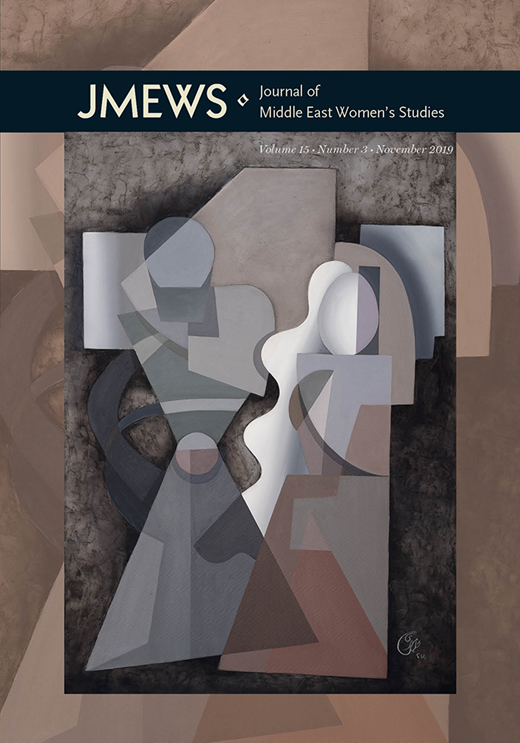
Volume 15.3 now available online!
JMEWS Volume 15:3 is now live! Check out our line-up of articles onlinetoday!
Our cover features Mehri Khalil’s Bride and Groom, a geometric depiction of two nameless and faceless figures who represent us all. Walking side by side, these figures variously intersect and stand apart. Khalil’s art demonstrates that however momentary or subliminal, all people, objects and ideas connect with each other on some level and at some point throughout their individual yet imbricated journeys.
-
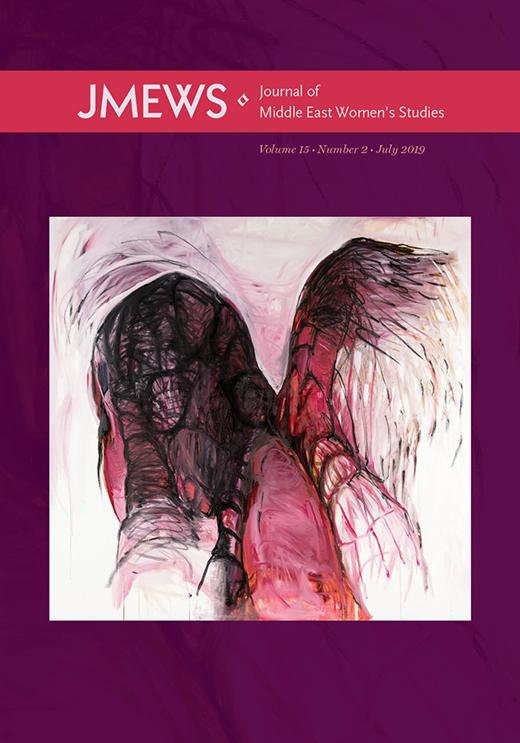
15.2 Available Online!
We are pleased to announce that the newest issue of the Journal of Middle East Women’s Studies is now available online!
Volume 15:2’s cover is graced by Hala Al Khalifa’s She Wore Her Scars like Wings, 13 (2016), depicting the joint of a feathered wing doubling as a heart, seeping red not unlike an open, webbed wound. Al Khalifa’s wing-heart throbs with unimaginable pain but is also soothed by the hands of angels, taking flight despite, or because of, its suffering.
15:2 includes articles and essays by Mejdulene B. Shomali, Nelia Hyndman-Rizk, Jakob Krais, Sabiha Allouche, Katja Žvan Elliott, Mehammed Amadeus Mack, Jonathan Wyrtzen, Gülhan Balsoy, Kathryn Medien, Danya Al-Saleh, Madawi Al-Rasheed, Amélie Le Renard and Hana Al-Khamri. In each of their pieces our authors trace the overlapping, tangled threads constituting the human relationships represented by their subjects—relationships rooted firmly in individual bodies and yet shared across a wide and arcing web of common histories and experiences.
Read 15:2’s line up of articles, book reviews and other content here!
-
Congratulations to the 2018 AMEWS Book Prize Winner and Honorable Mention!
AMEWS/JMEWS offers its warmest congratulations to the 2018 AMEWS Book Prize Winner and Honorable Mention!
The 2018 AMEWS was awarded to Attiya Ahmad, for her Everyday Conversions: Islam, Domestic Work, and South Asian Migrant Women in Kuwait (Duke University Press, 2017).

This excellent book is the product of several years Attiya Ahmad spent in Kuwait and some time in Nepal. From the beginning Ahmad inserts herself as a transnational Canadian-Pakistani feminist Muslim into this keenly observed, and deeply textured ethnography of South Asian women, some of them have lived in Kuwait for up to 40 years. She explores the question: Why are domestic workers converting to Islam in the Arabian Gulf region? In Everyday ConversionsAhmad presents us with an original analysis of this phenomenon.
The book begins and ends with Islamic centers: first, Al-Huda a Pakistani Urdu-speaking women’s movement; finally, Kuwait’s Islamic Da’wa Women’s Center for international non-Muslims and Muslims wanting to deepen their faith. Ahmad analyzes women’s transnational suspension between Kuwaiti and South Asian homes. Each chapter begins with a vignette that is then elaborated through “storytelling” that consists of recorded conversations and intricate observations that draw the reader into an almost novelistic account of the lives of her 24 subjects.
The definition of “everyday conversions” emerges gradually throughout the book so that we understand conversion not as a strictly religious phenomenon but as a total and very gradual change that ultimately motivates a religious decision as the culmination of everyday conversions. Ahmad contests the usual reasons given for migrants’ conversions and unrolls the patterns of their daily lives to show that conversion is not a sudden response to coercion or a desire for better treatment but a slow acceptance of fitraand Islam’s accommodation of previous religious identities by naramwomen.
One of the book’s key words is naram, a term applied to South Asian women. Naram, far from unskilled labor, “requires the development of skills, language abilities, and sets of cross-cultural and religious knowledge, but also necessitates the cultivation of dispositions and ongoing self-disciplining with respect to interpersonal interactions.” It entails emotional labor to fit into specific households: “being naramis like glue for women’s families… it resonates with the fluid, flexible student-centered pedagogies of Kuwait’s Islamic da’wa movement, thus facilitating domestic workers’ learning of Islamic precepts and practices.” Kuwait’s Da’wa movement develops “a contingent form of cosmopolitanism based on resonance, not synthesis or dialectic” and does not supersede previous identities.
Ahmad considers the household central to the production of ethno-national and transnational belongings and subjectivities. The temporariness of their jobs and their personal suspension between two homes should not to be resolved into diasporic identity that indicates discomfort. “Dual agents of reproduction,” they are considered “essential to the everyday functioning” of both households. From remittances to South Asia to immersion in their Kuwaiti families, from birth to death, produces real affection. Ahmad’s analysis of the kafala system and changing relationships between Kuwaitis and growing numbers of migrant workers highlights the importance of gender with men segregated in dormitories and poor accommodations (where she stayed) and women being part of every aspect of Kuwaitis’ lives.
In examining the connections between migration, labor, gender, and Islam, Ahmad complicates conventional understandings of the dynamics of religious conversion and the feminization of transnational labor migration. She proposes the concept of everyday conversion as a way to think more broadly about emergent forms of subjectivity, affinity, and belonging.
For book cover description, please visit publisher site.
Honorable Mention for the 2018 Prize went to Mehammed Amadeus Mack, for his Sexagon: Muslims, France and the Sexualization of National Culture (Fordham University Press, 2017)

Building on France’s moniker as the hexagon, Mehammed Amadeus Mack’s Sexagoncritically examines the way the figure of the young, virile, hypermasculine Muslim from the banlieues of Paris serves as a counterpoint to liberal French secular society’s understanding of gender and sexuality. Surveying a wide range of representations of young Muslim men and women in the banlieuesof Paris, Mack demonstrates how North African immigrant and diasporic communities in France are shaped through postmulticultural discourses of inclusion and exclusion that depend on sexualized assumptions about these communities.
Mack’s book is a sophisticated study that provides deep analysis of wide range of sources and employs a cultural studies framework in a way that challenges canonical queer theories. In particular, Mack’s troubling of liberal-secularist “coming out” narratives through a critical interrogation of clandestinity opens up new ways of thinking about visibility in relation to queerness and queer communities in the Franco-Arab context. Theorizing sexual clandestinity as a site for unregulated possibilities, whether liberatory or not, Sexagoncan be aligned with cutting edge work in queer of color theory.
Using the analytic of “virility,” rather than masculinity, to explore elements of vigor, assertiveness, combativeness, and ambition in Franco-Arab men and women of the banlieues, Mack shows how Muslim youth work on and against narratives that cast them as both hypersexualized and subject to sexually intolerant cultures.
Taken together, the organizing concepts of clandestinity and virility demonstrate how Franco-Arab youth have found ways of subverting the official scrutiny of the French Republic and to thwart its desires for universalism and transparency. Clandestinity, in its impenetrability, at once baffles liberal-savior narratives of sexual liberation and homonormativity even as it creates more complex queerings of intersectional identities.
For book cover description, please visit publisher site.
-
Congratulations to Shaherzad Ahmadi, Winner of the 2018 Graduate Student Paper Prize!
Warmest congratulations to Shaherzad Ahmadi, now of the University of St. Thomas, whose paper “‘In My Eyes He Was a Man’: Poor and Working-Class Boy Soldiers in the 1980-1988 Iran-Iraq War” was awarded JMEWS’s 2018 Graduate Student Paper Prize!
-
AMEWS Letter on Arrests of Iranian Women Activists
The Human Rights Task Force of the Association for Middle East Women’s Studies (AMEWS), an affiliate of the Middle East Studies Association (MESA), stands in solidarity with Iranian women political prisoners and all those indicted for opposing the compulsory hijab, now known collectively as ‘Girls of Revolution Street.’ Among them are well known human rights activists including Vida Movahed, Narges Hosseini, Maryam Shariatmadari, and Shaprak Shajarizad. Leila Hosseinzadeh, an anthropology student, labor and women’s rights activist, who was arrested after the December protests along with other student activists faces a six-year prison sentence. Nasrin Sotudeh, a feminist, a leading human rights attorney and defender of many of the Girls of Revolution Avenue is imprisoned and faces a five-year prison sentence.
Already serving long prison sentences are Narges Mohammadi, a journalist, women’s rights and human rights activist, and deputy director of the Center for the Defenders of Human Rights in Iran, founded by Nobel Peace Laureate Shirin Ebadi; Zeynab Jalalian, a Kurdish political activist who was arrested and imprisoned in 2008 for her activities with the political wing of the Kurdistan Workers’ Party; Golrokh Iraee, writer who has been in prison since October 2016 serving a six-year prison sentence for writing an unpublished story against the barbaric practice of stoning; and Atena Daemi a women’s and children’s rights activist who has been imprisoned since May 2015 and serving a seven-year prison sentence since November 2016 for charges such as distributing flyers against the death penalty, meeting the families of political prisoners, criticizing the Islamic Republic of Iran on Facebook and condemning the 1988 mass executions of political prisoners in Iran.
The women’s human rights activists were charged with spurious offenses such as “inciting corruption and promoting prostitution.” The Association for Middle East Women’s Studies urges the Iranian government to drop charges and immediately release these political prisoners, and to follow international human rights law in dealing with all future political protestors and social justice activists.
In solidarity,
AMEWS Human Rights Task Force
Nancy Gallagher, Chair, University of California, Santa Barbara
Sondra Hale, University of California, Los Angeles
Nadje Al-Ali, SOAS University of London
Anita Fabos, IDCE Clark University
Hind Ahmed Zaki, Harvard University
Angie Abdelmonem, Arizona State University

